
0. 写在前面
MoE 论文和模型报告里常见的词包括 top-k routing、shared expert、loss-free balance、dropless、EP、GroupedGEMM、DeepEP。落到训练框架里,这些词会变成一条更具体的执行链:
hidden states 先经过 router 选专家,再被 token dispatcher 重排和跨 rank 发送,随后进入本地 experts 做 GroupedGEMM,最后再 combine 回原 token 顺序。
这篇基于 Megatron-LM bb5647a 附近的 megatron/core/transformer/moe/ 源码整理。目的不是逐行讲源码,而是把几个关键部件的实现口径讲清楚:
- MoE layer 的主执行路径在哪里;
- gating 和 top-k routing 如何产生
routing_map和probs; - aux / seq aux / global aux / z-loss 分别在哪一步接入;
- loss-free expert bias 在训练时如何统计、如何更新;
- token dropping / capacity 是怎么发生的;
- allgather / alltoall / flex dispatcher 各自承担什么;
- latent MoE 和 shared expert 在 Megatron 里怎么接入。
从实现结构看,Megatron Core 里的 MoE 不是一个单独 layer,而是一组 router、dispatcher、expert kernel、balance controller 和并行通信协议拼起来的系统。
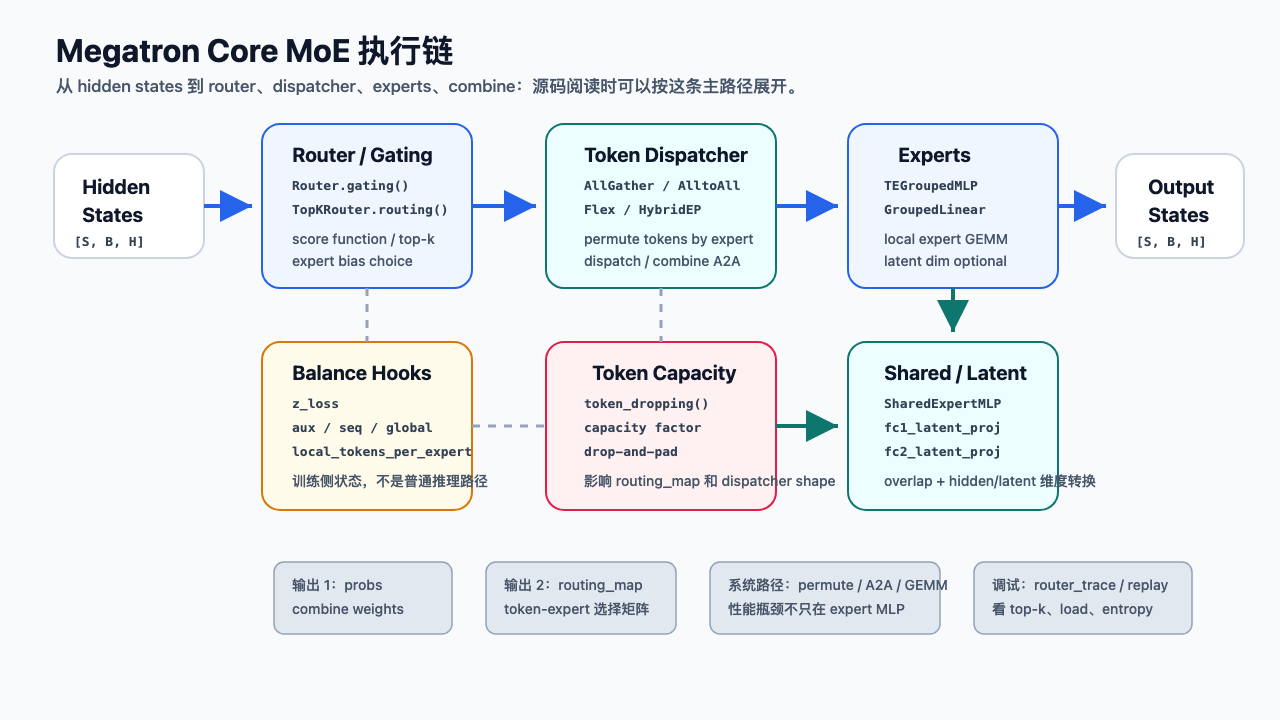
图 1:读 Megatron Core MoE 源码时,可以先按 route -> dispatch -> experts -> combine 这条主路径定位,再分别展开 router loss、expert bias、token capacity、shared/latent expert 等旁路状态。
后面的代码块都是按 Megatron-LM bb5647a 附近源码做的删节版,只保留关键分支和状态流转。这样比整段源码更容易看出设计意图,也避免把正文变成逐行注释。
1. 源码地图
先把关键文件放在一张表里。
| 文件 | 主要角色 |
|---|---|
moe_layer.py |
MoE layer 主入口,负责 route、preprocess、dispatch、expert compute、combine |
router.py |
Router / TopKRouter / InferenceTopKRouter,实现 gating、routing、aux loss、expert bias 统计 |
moe_utils.py |
top-k routing、load-balance loss、z-loss、token dropping、permute/unpermute、expert bias update |
token_dispatcher.py |
allgather、alltoall、flex/hybrid EP token dispatcher |
experts.py |
TEGroupedMLP、SequentialMLP、inference grouped MLP |
shared_experts.py |
shared expert MLP、overlap 和 fused shared expert path |
router_replay.py |
记录/回放 routing 决策,用于调试或一致性分析 |
router_trace.py |
捕获 top-k ids、weights、logits 等 routing trace |
这几个文件的依赖关系大致是:
| 阶段 | 入口 | 产物 |
|---|---|---|
| route | MoELayer.route() -> TopKRouter.forward() |
probs, routing_map |
| preprocess | MoELayer.preprocess() |
latent projection、dispatcher metadata |
| dispatch | token_dispatcher.token_dispatch() |
expert-major tokens、tokens per expert |
| expert compute | TEGroupedMLP.forward() |
local expert outputs |
| combine | token_dispatcher.token_combine() + combine_postprocess() |
回到原 token 顺序的 hidden states |
理解 Megatron MoE,建议按这条链读源码,而不是从某一个 flag 开始看。
2. MoE layer 主路径:route -> dispatch -> experts -> combine
moe_layer.py 里的 MoELayer 是最适合开始的地方。
初始化阶段主要做几件事:
| 组件 | 源码位置 | 说明 |
|---|---|---|
| router | self.router = ... |
选择 top-k experts,生成 routing map |
| latent projection | fc1_latent_proj / fc2_latent_proj |
moe_latent_size 打开后,把 routed expert path 放到 latent dim |
| token dispatcher | MoEAllGatherTokenDispatcher / MoEAlltoAllTokenDispatcher / MoEFlexTokenDispatcher |
决定 token 如何重排、通信、送到本地 experts |
| experts | self.experts |
通常是 TEGroupedMLP 或其它 expert MLP |
| shared experts | self.shared_experts |
always-on 或 overlap 的 shared expert path |
forward 的逻辑可以概括成:
| 步骤 | 做什么 | 关键状态 |
|---|---|---|
| route | router 读 hidden states,输出每个 token 的 top-k experts | probs, routing_map |
| preprocess | latent projection、dispatcher 预处理、统计 tokens per expert | dispatcher metadata |
| dispatch | token 按 expert-major 顺序排列,并跨 EP rank 发送 | permuted tokens |
| shared experts | 可与 routed path overlap | shared expert output |
| routed experts | 本地 experts 做 MLP/GroupedGEMM | expert output |
| combine | all-to-all 回传、unpermute、按 router probs 加权合并 | final hidden states |
这条路径说明,MoE 的瓶颈不一定在 expert MLP。router、permute、all-to-all、combine、shared expert overlap、latent projection 都可能成为实际吞吐里的关键段。
先把完整 forward 压成一段伪代码:
hidden_in = hidden
probs, routing_map = router(hidden)
hidden, probs = dispatch_preprocess(hidden, routing_map, probs)
permuted_hidden, permuted_probs = dispatch(hidden, probs)
expert_out = experts(permuted_hidden, permuted_probs)
hidden = combine(expert_out, probs)
hidden = shared_expert(hidden_in) + hidden if use_shared_expert else hidden
可以先看 MoELayer 的删节版主路径。注意:router 只负责产生 probs 和 routing_map,真正把 token 发到各个 expert rank 的是 dispatcher。
class MoELayer(BaseMoELayer):
    def route(self, hidden_states, padding_mask=None):
        probs, routing_map = self.router(hidden_states, padding_mask)
        return probs, routing_map

    def preprocess(self, hidden_states, probs, routing_map):
        if self.config.moe_latent_size:
            hidden_states, _ = self.fc1_latent_proj(hidden_states)
        hidden_states, probs = self.token_dispatcher.dispatch_preprocess(
            hidden_states, routing_map, probs
        )
        return hidden_states, probs

    def dispatch(self, hidden_states, probs):
        return self.token_dispatcher.token_dispatch(hidden_states, probs)

    def routed_experts_compute(self, hidden_states, probs):
        dispatched_input, tokens_per_expert, permuted_probs = (
            self.token_dispatcher.dispatch_postprocess(hidden_states, probs)
        )
        expert_output, mlp_bias = self.experts(
            dispatched_input, tokens_per_expert, permuted_probs
        )
        return self.token_dispatcher.combine_preprocess(expert_output), mlp_bias

    def combine(self, output):
        return self.token_dispatcher.token_combine(output)
3. Gating:router logits 从哪里来
router.py 里最基础的抽象是 Router.gating()。它做的事情直接:把输入 hidden states 喂给一个 linear gate,得到每个 token 对每个 expert 的 logits。
关键代码不长,但信息量很大:router 计算可以强制转到 FP32/FP64,再通过 router_gating_linear 得到 logits。
def gating(self, input: torch.Tensor):
    if self.weight.device.type == "cpu":
        self.weight.data = self.weight.data.to(device=torch.cuda.current_device())
    if self.bias is not None and self.bias.device.type == "cpu":
        self.bias.data = self.bias.data.to(device=torch.cuda.current_device())

    router_dtype = input.dtype
    if self.config.moe_router_dtype == "fp32":
        router_dtype = torch.float32
    elif self.config.moe_router_dtype == "fp64":
        router_dtype = torch.float64

    logits = router_gating_linear(input, self.weight, self.bias, router_dtype)
    return logits
几个实现细节值得注意。
第一,router dtype 是显式配置的。Megatron 会把 router 输入转到 moe_router_dtype,常见选择是 FP32 或 FP64。大专家数、sigmoid/top-k、expert bias 混用时,router logits 的微小差异可能改变 top-k,所以 router 精度通常要比普通 FFN 更谨慎。
第二,router_gating_linear 可以走 fused autograd function。MoE router 是小算子,但每层每步都跑,kernel launch 和精度都重要,所以 Megatron 把 router fusion 放进性能优化路径。
第三,Router 本身只定义接口,真正的 routing 逻辑在 TopKRouter 和 InferenceTopKRouter。
| 类 | 用途 |
|---|---|
Router |
基类,负责 gating linear 和 dtype |
TopKRouter |
训练路径,包含 z-loss、load-balance loss、token dropping、expert bias 统计 |
InferenceTopKRouter |
推理路径,去掉训练侧 aux loss、z-loss、token dropping 和 bias update 等开销 |
这一点对第七篇很重要:训练和推理不是同一条 router path。即使权重一样,训练 runtime 和 serving runtime 也可能因为 router dtype、bias 处理、renormalize、top-k tie-breaking 而产生不一致。
4. TopKRouter:从 logits 到 routing_map
TopKRouter.routing() 是训练时最核心的函数。它大致做下面几件事:
| 顺序 | 逻辑 | 相关函数 |
|---|---|---|
| 1 | flatten logits,处理 padding mask | routing() |
| 2 | 训练时可附加 router z-loss | apply_z_loss() / z_loss_func() |
| 3 | 根据 balance 类型选择 routing 方法 | sinkhorn_load_balancing() / quantile_balancing() / topk_routing_with_score_function() |
| 4 | 如果配置 capacity factor,应用 token dropping | apply_router_token_dropping() |
| 5 | 训练时附加 aux / seq aux / global aux loss | _apply_aux_loss() 等 |
| 6 | 统计本 batch 的 expert load,用于 expert bias 更新 | _apply_expert_bias() |
最终输出两个东西:
| 输出 | 含义 |
|---|---|
probs |
token 对选中 experts 的 combine weights |
routing_map |
token-expert 的布尔/稀疏选择矩阵 |
routing_map 是后面 dispatcher 的核心输入。dispatcher 不关心论文里叫 top-8 还是 top-6,它关心的是哪些 token 要发到哪些 expert 上。
把 TopKRouter.routing() 压缩以后,主线可以概括为:先算 routing,再可选 token dropping,再把训练侧 aux loss 和 expert bias 统计挂上去。
def routing(self, logits, padding_mask=None):
    seq_length, bsz = logits.shape[:2]
    logits = logits.view(-1, self.config.num_moe_experts)

    if padding_mask is not None:
        padding_mask = padding_mask.reshape(-1)

    logits = self.apply_z_loss(logits, padding_mask=padding_mask)

    if self.routing_type == "sinkhorn":
        probs, routing_map = self.sinkhorn_load_balancing(logits)
    elif self.routing_type == "quantile_balancing":
        probs, routing_map = self.quantile_balancing(logits)
    else:
        probs, routing_map = topk_routing_with_score_function(
            logits,
            self.topk,
            score_function=self.score_function,
            expert_bias=self.expert_bias,
            fused=self.config.moe_router_fusion,
        )

    if self.config.moe_expert_capacity_factor is not None:
        probs, routing_map = apply_router_token_dropping(
            probs,
            routing_map,
            router_topk=self.topk,
            capacity_factor=self.config.moe_expert_capacity_factor,
            drop_policy=self.config.moe_token_drop_policy,
            pad_to_capacity=self.config.moe_pad_expert_input_to_capacity,
        )

    if self.training and torch.is_grad_enabled() and self.is_aux_loss_enabled():
        probs = self._apply_aux_loss(...)
        probs = self._apply_seq_aux_loss(...)
        probs = self._apply_global_aux_loss(...)

    self._apply_expert_bias(routing_map, padding_mask=padding_mask)
    return probs, routing_map
5. Score function:softmax、sigmoid、sqrtsoftplus
Megatron 的 topk_routing_with_score_function() 支持多种 score function,包括 softmax、sigmoid 和 sqrtsoftplus。这里的关键不是名字,而是“选择专家的分数”和“合并输出的权重”是否一致。
常见口径如下:
| 口径 | 选择专家 | combine weight |
|---|---|---|
| softmax | 对所有 experts softmax 后 top-k | top-k 概率,可 renormalize |
| sigmoid | 每个 expert 独立 sigmoid 后 top-k | top-k 分数再 normalization |
| expert bias | 用 score + bias 参与选择 | combine weight 通常仍来自原 score |
| group-limited routing | 先选 expert group,再在 group 内选 top-k | group 内 top-k weights |
expert bias 的 choice-only 语义很关键。Megatron 在 moe_utils.py 中会把 expert_bias 加到 scores_for_routing 上参与 top-k 选择,但输出权重仍然来自原始 scores。这和 DeepSeek-style loss-free balance 的设计目标一致:bias 用来控制负载,不直接改变专家输出的 mixture weight。
这段实现是理解 loss-free balance 和 serving 对齐的关键。对于 sigmoid / sqrtsoftplus,bias 参与的是 top_indices 的选择,scores 会重新从原始 score 里 gather 出来,再归一化成 combine weights。
if score_function == "softmax":
    if use_pre_softmax:
        scores = torch.softmax(logits, dim=-1, dtype=torch.float32)
        probs, top_indices = compute_topk(scores, topk, num_groups, group_topk)
    else:
        scores, top_indices = compute_topk(logits, topk, num_groups, group_topk)
        probs = torch.softmax(scores, dim=-1, dtype=torch.float32)

elif score_function in ("sigmoid", "sqrtsoftplus"):
    if score_function == "sigmoid":
        scores = torch.sigmoid(logits.float())
    else:
        scores = torch.nn.functional.softplus(logits.float()).sqrt()

    if expert_bias is not None:
        scores_for_routing = scores + expert_bias.float()
        _, top_indices = compute_topk(scores_for_routing, topk, num_groups, group_topk)
        scores = torch.gather(scores, dim=1, index=top_indices)
    else:
        scores, top_indices = compute_topk(scores, topk, num_groups, group_topk)

    probs = scores / (scores.sum(dim=-1, keepdim=True) + 1e-20)
如果 serving runtime 把 bias 直接混进 combine weights,或者 renormalize 口径不同,就会出现训练-推理不一致。
6. Load balance:aux、seq aux、global aux、z-loss 和 QB
Megatron 同时支持多种 router 相关 loss。它们听起来相近,但目的不同。
| 机制 | 源码入口 | 解决什么 |
|---|---|---|
| aux loss | _apply_aux_loss() / switch_load_balancing_loss_func() |
micro-batch 粒度的 expert load balance |
| seq aux loss | _apply_seq_aux_loss() |
以 sequence 为统计单位,让每条样本内部更平滑 |
| global aux loss | _apply_global_aux_loss() |
跨 micro-batch / global 统计更稳定 |
| z-loss | apply_z_loss() / z_loss_func() |
抑制 router logits 过大,提升 router 数值稳定性 |
| sinkhorn | sinkhorn_load_balancing() |
用近似 assignment 的方式做均衡路由 |
| quantile balancing | quantile_balancing() |
用 dual / quantile 状态调节专家选择,禁用 aux loss |
switch_load_balancing_loss_func() 的核心形式可以理解为 num_experts * sum(f_i * P_i):f_i 是 tokens 实际分配到 expert 的比例,P_i 是 router 概率质量。它想惩罚“概率给很多但实际不均”或“实际集中到少数专家”的情况。
但从 pretraining recipe 看,aux loss 不应越强越好。它能救 router collapse,也可能干扰主 LM objective。现在更稳的用法是:loss-free expert bias 做主 balance,aux/seq/global loss 做轻量稳定器。
Quantile Balancing 是另一条路:它不用 aux loss 接管主目标,而是在 router 里维护 qb_beta。当前 batch routing 用的是 scores - qb_beta,随后根据每个 expert 的分位数阈值累计下一轮 qb_beta。
Megatron 里的实现要点很集中:
| 状态/函数 | 作用 |
|---|---|
moe_router_load_balancing_type="quantile_balancing" |
选择 QB 路由,要求 aux loss coeff 为 0 |
qb_beta |
persistent buffer,每个 expert 一个动态价格 |
qb_beta_accum / qb_beta_count |
非 persistent buffer,累计 microbatch quantile |
qb_dual_update() |
用 scores - beta 选 top-k,并估计每列 quantile |
topk_routing_with_score_function(..., precomputed_indices=indices) |
QB 只决定 top-k ids,combine weights 仍按普通 score function 计算 |
伪代码大概是:
indices, beta_local = qb_dual_update(scores, topk, qb_beta)
qb_beta_accum += beta_local
probs, routing_map = score_function(scores, precomputed_indices=indices)
这个设计和 choice-only expert bias 的精神类似:负载控制影响“选谁”,但不直接把控制器状态混进 combine weights。区别在于普通 expert bias 往往按实际 load 加减一步,QB 则用每个 expert 的分位数阈值估计下一轮价格。
7. Expert bias:loss-free balance 在代码里是什么状态
TopKRouter.__init__() 里如果 moe_router_enable_expert_bias 打开,会注册两个状态:
| 状态 | persistent | 用途 |
|---|---|---|
expert_bias |
是 | 保存每个 expert 的 routing bias,参与 checkpoint |
local_tokens_per_expert |
否 | 当前 step / micro-batch 统计的 expert token count |
几个细节很重要。
第一,expert_bias 会被保持为 FP32。源码里有 _maintain_float32_expert_bias(),原因很明确:低精度 bias 更新会放大 routing error。
第二,_apply_expert_bias() 只在 torch.is_grad_enabled() 时累计 local_tokens_per_expert。也就是说,它是训练路径里的统计状态,推理路径不会继续更新。
第三,真正更新 bias 的逻辑在 moe_utils.get_updated_expert_bias()。具体规则是:如果某个 expert 负载高于均值,就沿一个方向调 bias;如果低于均值,就反向调。更新幅度由 moe_router_bias_update_rate 控制。
这里可以把 expert bias 当成一个轻量的负载控制器:
| 专家状态 | bias 行为 | 目标 |
|---|---|---|
| 过载 | 降低被选中概率 | 把 token 推给其它专家 |
| 欠载 | 提高被选中概率 | 吸引更多 token |
| 接近均衡 | 小幅或不更新 | 保持稳定 |
这也解释了为什么后训练阶段通常 freeze bias update:SFT/RL 的 batch 分布太窄,继续更新控制器,等于让专家负载按小数据重新定标。
代码里也能看出它为什么更像 controller state,而不是普通反向传播参数。_apply_expert_bias() 只累计 token count;真正的 bias 更新按专家负载和平均负载的符号方向走一步。
def _apply_expert_bias(self, routing_map, padding_mask=None):
    if self.enable_expert_bias and torch.is_grad_enabled():
        with torch.no_grad():
            if padding_mask is not None:
                routing_map = routing_map & (~padding_mask)
            self.local_tokens_per_expert += routing_map.sum(dim=0)


def get_updated_expert_bias(tokens_per_expert, expert_bias, update_rate, group):
    with torch.no_grad():
        torch.distributed.all_reduce(tokens_per_expert, group=group)
        average_tokens = tokens_per_expert.sum(dim=-1, keepdim=True)
        average_tokens = average_tokens / tokens_per_expert.shape[-1]
        offset = average_tokens - tokens_per_expert
        return expert_bias + torch.sign(offset) * update_rate
8. Token dropping:capacity factor 什么时候会丢 token
MoE 里 dropless 是常见目标,但框架里通常仍保留 capacity / drop 逻辑。Megatron 的 token dropping 主要由 moe_expert_capacity_factor 和 moe_pad_expert_input_to_capacity 控制。
在 TopKRouter.routing() 中,如果 moe_expert_capacity_factor 不为空,会调用 apply_router_token_dropping()。它会根据每个 expert 的 capacity 裁掉超出部分的 token routing,再让后续 dispatcher 只处理保留下来的 token。
删节版实现如下。drop_policy="probs" 时,每个 expert 保留 routing probability 最高的前 capacity 个 token;drop_policy="position" 时,则按 routing_map 的位置保留。
def apply_router_token_dropping(
    routing_probs,
    routing_map,
    router_topk,
    capacity_factor,
    drop_policy="probs",
    pad_to_capacity=False,
):
    num_tokens, num_experts = routing_probs.shape
    expert_capacity = get_capacity(
        num_tokens=num_tokens * router_topk,
        num_experts=num_experts,
        capacity_factor=capacity_factor,
    )

    if expert_capacity > num_tokens:
        capacity_mask = torch.ones_like(routing_probs).bool()
    elif drop_policy == "probs":
        _, capacity_indices = torch.topk(
            routing_probs, k=expert_capacity, dim=0, sorted=False
        )
        capacity_mask = torch.zeros_like(routing_probs).scatter(0, capacity_indices, 1).bool()
    elif drop_policy == "position":
        _, capacity_indices = torch.topk(
            routing_map.int(), k=expert_capacity, dim=0, sorted=False
        )
        capacity_mask = torch.zeros_like(routing_probs).scatter(0, capacity_indices, 1).bool()

    final_map = capacity_mask if pad_to_capacity else routing_map & capacity_mask
    final_probs = routing_probs * final_map
    return final_probs, final_map
在 all-to-all dispatcher 里,drop_and_pad 又会影响 buffer shape:
| 模式 | 行为 | 影响 |
|---|---|---|
| dropless | output size 通常是 num_tokens * topk |
不丢 token,但 shape 可能随路由动态变化 |
| drop | 超过 expert capacity 的 token 被裁掉 | 稳定显存/通信,但会改变训练信号 |
| drop-and-pad | 丢掉超 capacity token,并 pad 到固定 capacity | 更适合静态 shape / CUDA Graph,但会浪费 padding compute |
| expert-rank capacity | 给每个 EP rank 设置 upper bound | 控制 rank-level overflow 和 HybridEP buffer |
训练 recipe 上,通常建议先 dropless 跑稳。token drop 适合作为保护机制或极端内存约束下的选择,不应该在还没搞清楚 router/load 之前就打开。
第七篇里还会讲:如果训练时用了 capacity/drop,而 serving 时是 dropless,这本身就是一种训推不一致。
9. Token dispatcher:allgather、alltoall、flex
Megatron 的 token dispatcher 负责把 token 从原始 sequence-major layout 变成 expert-major layout,并在 EP ranks 之间通信。
| Dispatcher | 适用口径 | 主要特点 |
|---|---|---|
MoEAllGatherTokenDispatcher |
小规模或简单 correctness path | gather 后本地筛 token,逻辑直观但扩展性弱 |
MoEAlltoAllTokenDispatcher |
常规 EP 训练 | 先 permute,再 all-to-all,experts 计算后再 combine |
MoEFlexTokenDispatcher |
DeepEP / HybridEP / 高性能路径 | 把 dispatch/combine、permute、通信、静态 buffer 做更深融合 |
all-to-all 路径可以拆成:
| 阶段 | 做什么 |
|---|---|
| preprocess | 根据 routing_map 计算 tokens_per_expert、input/output splits |
| token permutation | 把 token 重排成 expert-major |
| dispatch all-to-all | token 发到 expert 所在 EP rank |
| dispatch postprocess | 本地再按 expert 排序,给 experts 准备输入 |
| combine preprocess | expert 输出准备回传 |
| combine all-to-all | 输出发回 token 原 rank |
| unpermute | 恢复原 token 顺序,并按 router weights 合并 |
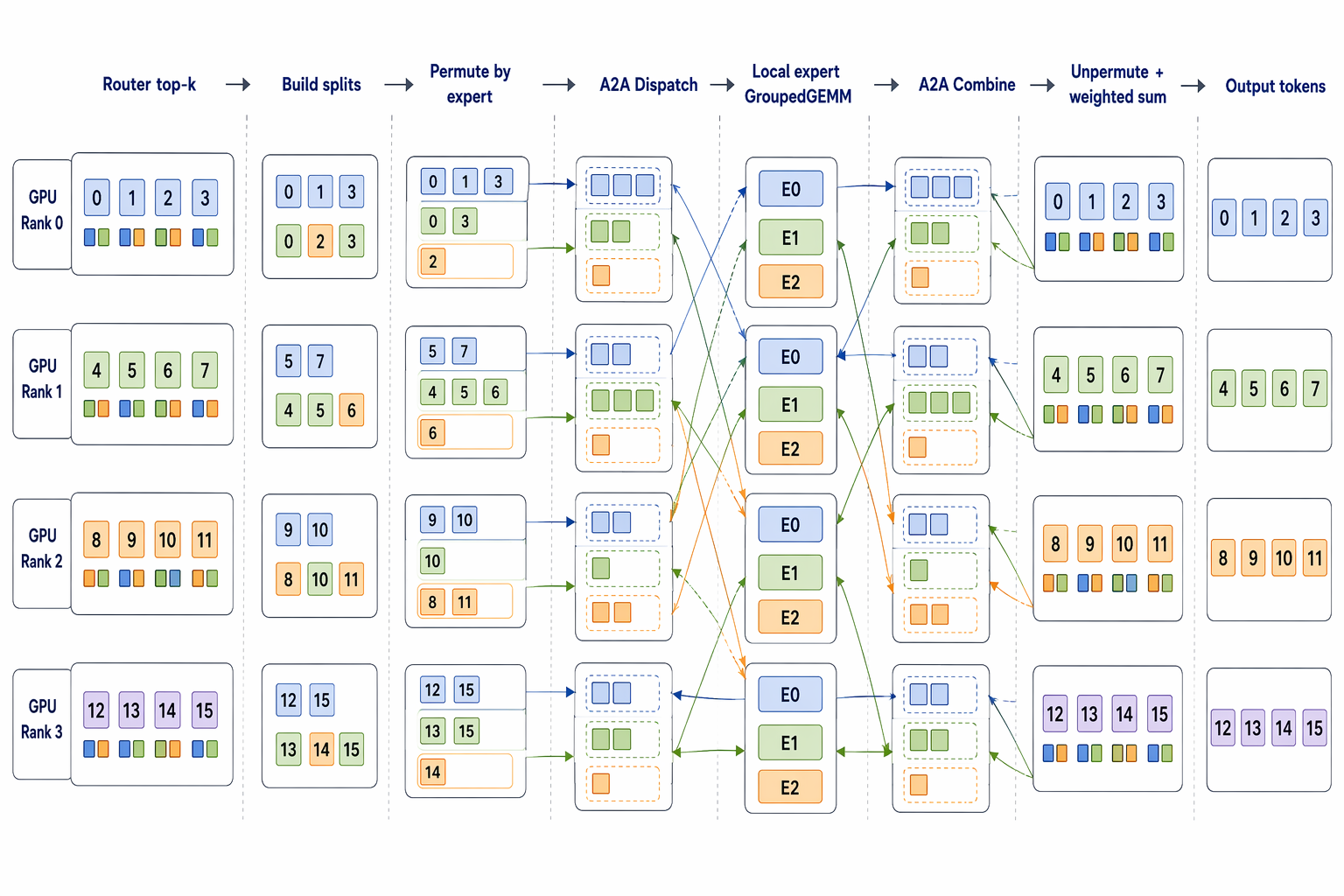
图 2:all-to-all dispatcher 可以拆成两次数据移动:dispatch 阶段把 token 按 expert 重新分组并发到 expert 所在 EP rank;combine 阶段再把 expert 输出发回原 token rank,最后 unpermute 并按 router weights 合并。
这条路径就是 MoE 通信墙的来源。只要 expert load 不均、跨节点 EP 太多、token permutation 太碎,active FLOPs 再低也会被 all-to-all 和 memory movement 拖住。
10. Experts:TEGroupedMLP 为什么重要
Megatron 的 routed experts 常走 TEGroupedMLP。它用 Transformer Engine 的 GroupedLinear 把多个本地 experts 的 MLP 合并成 grouped GEMM。
这比 naive “每个 expert 一个小 MLP 循环跑”重要得多。MoE 的每个 expert 只拿到一部分 token,如果逐 expert 单独 launch,小 GEMM 会非常低效。GroupedGEMM 的意义是把一批不同 expert 的矩阵乘组织成更适合 GPU 的执行方式。
TEGroupedMLP 里还有一个和 LatentMoE 相关的细节:如果 moe_latent_size 打开,expert 输入输出维度会使用 latent size,而不是完整 hidden size。这意味着 latent expert path 不只是 layer 外面套一个投影,experts 内部的参数和 compute 形状也随之改变。
| 专家实现 | 使用场景 |
|---|---|
TEGroupedMLP |
大规模训练默认关注,高效本地 grouped experts |
SequentialMLP |
correctness / fallback / 小规模调试 |
InferenceGroupedMLP |
推理路径,可接不同 inference grouped GEMM backend |
11. Shared expert 和 LatentMoE 的接入位置
shared expert 在 moe_layer.py 里不是 router 选出来的普通 expert,而是单独的 shared path。
常规路径下,shared expert 会直接读完整 hidden states,输出再和 routed experts 的结果相加。为了性能,Megatron 支持 shared expert overlap:shared expert 可以和 routed expert dispatch/compute 重叠,减少串行开销。
LatentMoE 打开后,路径更微妙:
| 部件 | 维度 |
|---|---|
| shared expert | 通常读完整 hidden dim |
| routed experts | 可在 latent dim 上计算 |
fc1_latent_proj |
hidden dim -> latent dim |
fc2_latent_proj |
latent dim -> hidden dim |
源码里对 inference + NVLS dispatcher + latent MoE 的 shared expert overlap 做了专门处理:shared expert 需要在降维前运行,routed expert 输出需要在升维后再和 shared expert output 相加。这个细节说明,LatentMoE 不是单纯改 expert MLP hidden size,它会影响 shared path、dispatcher、推理 overlap 和 checkpoint 兼容。
12. 训练路径和推理路径并不完全一样
Megatron 里有 InferenceTopKRouter,这一点对训推一致性很关键。
训练时 TopKRouter 会处理:
- z-loss;
- aux / seq aux / global aux loss;
- token dropping;
- expert bias load 统计;
- padding mask 和训练态 logging;
- quantile balancing 的状态累计;
- router trace / replay 等调试逻辑。
推理时 InferenceTopKRouter 会尽量去掉这些训练开销,只保留 top-k routing 需要的东西。对 serving 来说这是合理的;对后训练/RL 来说,这也埋下了训推不一致的入口。
因此,debug MoE RL 或 serving 一致性时,不能只问“checkpoint 权重是不是一样”,还要问:
| 问题 | 为什么重要 |
|---|---|
| expert bias 是否被保存并正确加载 | bias 影响 top-k choice |
| 推理是否使用同样 score function | softmax/sigmoid/sqrtsoftplus 不可混 |
| top-k 后是否 renormalize | combine weights 会变 |
| token dropping 训练时是否打开 | serving 通常不会丢 token |
| router dtype 是否一致 | 低精度可能翻转 top-k |
| group-limited routing 是否一致 | expert group 选择不同会改变路径 |
第七篇会以 Megatron + SGLang 为例展开这一点。
13. Router replay / trace:把路由指标纳入监控
Megatron 里有 router_replay.py 和 router_trace.py。这两个工具类模块常被忽略,但对 MoE 研究有价值。
| 工具 | 用途 |
|---|---|
| router trace | 捕获 top-k ids、weights、logits、tokens-per-expert 等 routing 信息 |
| router replay | 复用或回放某次 routing 决策,用来排查 router 变化造成的训练差异 |
这给 MoE 调试提供了一个直接入口:除了 loss 曲线,还要看 route entropy、top-k overlap、expert load CV、device load CV。很多 MoE 问题在 loss 爆之前,已经会先反映到这些路由指标里。
对 SFT/RL 阶段尤其如此。固定一套 probe corpus,每个 checkpoint 跑 router trace,比只看 benchmark 更早发现 route drift。
14. 读源码时常见的混淆点
| 容易混淆的点 | 更准确的理解 |
|---|---|
| expert bias 是普通参数吗 | 更像负载控制器状态,参与 checkpoint,但更新不靠主 loss 反传 |
| loss-free 是完全不用 aux loss 吗 | 不一定。主平衡靠 bias,轻量 seq/global aux 仍可作为稳定器 |
| dropless 是没有 capacity 逻辑吗 | 不是。框架通常仍保留 capacity/drop/pad 逻辑,只是默认不丢 |
| shared expert 是一个普通 expert 吗 | 通常不是 router top-k 选出来的 expert,而是单独 always-on path |
| EP 只是把 expert 切到不同 GPU 吗 | 还包括 token dispatch/combine、load balance、straggler、buffer 和通信 overlap |
| LatentMoE 只是 low-rank MLP 吗 | 不是。它改变 routed expert path 的维度、通信 payload、expert 参数和 shared path 交互 |
| 推理 router 等同训练 router 吗 | 不等同。训练 path 有 loss/bias/drop 统计,推理 path 通常只保留 choice/weights |
15. 和下一篇的衔接
这篇讲的是 Megatron Core 里 MoE 部件怎么实现。下一篇会把其中两个系统瓶颈单独放大:
- token dispatch/combine 的通信墙,对应 DeepEP / Flex Dispatcher;
- expert MLP 的计算效率墙,对应 GroupedGEMM / fused MoE GEMM。
源码层面看,DeepEP 和 GroupedGEMM 不只是普通加速开关。当 MoE 模型进入大 EP、多节点和高专家数后,它们决定的是 active FLOPs 能不能转化成 tokens/s。
系列导航
上一篇:第二篇:如果今天要 scaling MoE,架构和训练策略该怎么选
下一篇:第四篇:DeepEP 与 GroupedGEMM,MoE 大规模训练的通信墙和计算墙