
0. 导读:定义“100B MoE”
讨论 100B MoE 训练配置时,不能只给出 EP/TP/PP 的组合。更稳妥的做法是先明确参数构成、active params、并行切分和显存来源。下面定义会反复用到的量:
| 符号 | 含义 |
|---|---|
P_total |
总参数量,例如 100B |
P_dense |
非 routed expert 参数:attention、embedding、norm、router、dense warmup layers 等 |
P_routed |
routed expert 总参数 |
P_shared |
shared expert 参数,通常 always-on |
E |
每个 MoE layer 的 routed expert 数 |
k |
每 token 激活的 routed expert 数 |
rho_e = k / E |
expert activation ratio |
P_active |
每 token active params |
L |
总层数 |
L_moe |
MoE 层数 |
S |
context length |
mbs |
micro-batch size |
一个基本关系是:
| 量 | 粗略公式 |
|---|---|
| 总参数 | P_total = P_dense + P_shared + P_routed |
| 每 token active 参数 | P_active ~= P_dense + P_shared + (k / E) * P_routed |
| routed expert 稀疏度 | 1 - k / E |
需要注意:k/E 不是 active parameter ratio。attention、embedding、dense warmup、shared expert 都是 always-on,所以 active params 往往明显高于 P_total * k/E。
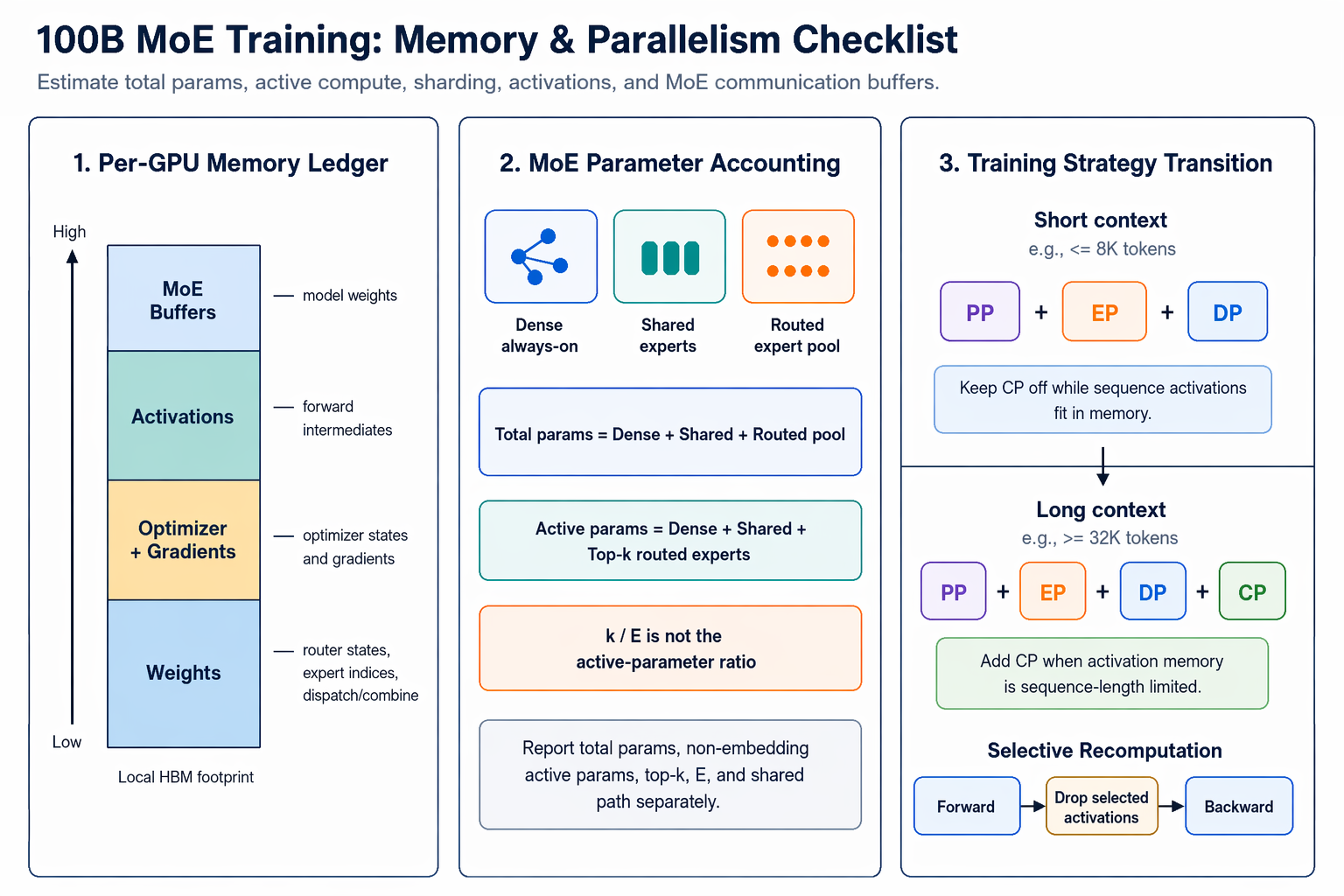 图 1:100B MoE 的显存估算可以拆成四类:weights、gradients/optimizer、activations、MoE dispatch buffers。active params 主要影响 FLOPs,但完整 routed weights 和 MoE buffer 仍要按并行策略估算。
1. Ling-flash-2.0:100B total params 怎么算出来
先用 Ling-flash-2.0 做一个更接近真实配置的参数账。它的公开口径是 100B total parameters、6.1B activated parameters,其中 non-embedding activated parameters 是 4.8B。这个例子适合说明:MoE 的 total params 主要来自“所有 routed experts 的参数池”,active params 则只计算每个 token 实际走到的专家。
1.1 先看关键配置
Ling-flash-2.0 的 config.json 里,和参数计算最相关的是这些字段:
| 字段 | 值 | 说明 |
|---|---|---|
num_hidden_layers |
32 | 总 Transformer 层数 |
hidden_size |
4096 | hidden dimension |
vocab_size |
157184 | 词表大小 |
first_k_dense_replace |
1 | 前 1 层是 dense MLP |
num_experts |
256 | 每个 MoE layer 的 routed experts 数 |
num_experts_per_tok |
8 | 每个 token 选 8 个 routed experts |
num_shared_experts |
1 | 每个 MoE layer 有 1 个 shared expert |
intermediate_size |
9216 | dense MLP intermediate size |
moe_intermediate_size |
1024 | 每个 routed/shared expert 的 intermediate size |
num_attention_heads / num_key_value_heads |
32 / 4 | GQA attention 配置 |
head_dim |
128 | attention head dimension |
所以层结构可以粗略理解为:
| 部分 | 数量 |
|---|---|
| dense MLP layer | 1 层 |
| MoE layer | 31 层 |
| routed experts per MoE layer | 256 个 |
| active routed experts per token | 8 个 |
| shared experts per MoE layer | 1 个 |
这里的 routed activation ratio 是 8 / 256 = 1 / 32。但这不等于全模型 active parameter ratio,因为 attention、embedding、第一层 dense MLP 和 shared expert 都是 always-on。
1.2 每个模块先算单元参数量
为了便于手算,先忽略 norm、QK norm、router bias 这类百万级以下的小项,只看主要矩阵。
Ling-flash-2.0 使用 SwiGLU 风格 MLP / expert,可以按三组矩阵估算:gate、up、down。因此一个 FFN 或 expert 的参数量近似是 3 x hidden_size x intermediate_size。
| 模块 | 公式 | 参数量 |
|---|---|---|
| 单个 routed expert | 3 x 4096 x 1024 |
12.58M |
| 单个 shared expert | 3 x 4096 x 1024 |
12.58M |
| 第一层 dense MLP | 3 x 4096 x 9216 |
113.25M |
| 单层 attention | Q + K + V + O |
37.75M |
| embedding | 157184 x 4096 |
643.83M |
| LM head | 157184 x 4096 |
643.83M |
| 单层 router | 4096 x 256 |
1.05M |
attention 这里因为是 GQA,K/V 的输出维度是 num_key_value_heads x head_dim = 4 x 128 = 512,所以单层 attention 近似为:
4096 x 4096 + 4096 x 512 + 4096 x 512 + 4096 x 4096 = 37.75M
1.3 total params:为什么接近 103B
把上面的单元参数量乘上层数,就能得到 total params 的主要构成:
| 部分 | 计算 | 参数量 |
|---|---|---|
| embedding + LM head | 2 x 157184 x 4096 |
1.29B |
| all attention | 32 x 37.75M |
1.21B |
| 第一层 dense MLP | 1 x 113.25M |
0.11B |
| routed experts | 31 x 256 x 12.58M |
99.86B |
| shared experts | 31 x 1 x 12.58M |
0.39B |
| routers | 31 x 4096 x 256 |
0.03B |
| 合计 | 主要矩阵相加 | 102.89B |
这就解释了为什么一个 hidden size 4096、只有 32 层的模型,也能做到 100B total params:每个 MoE layer 都有 256 个 routed experts,虽然每个 token 只激活 8 个,但 total params 要把 256 个专家全部算进去。
更具体地看,单个 MoE layer 的 routed expert 参数池就是:
256 x 12.58M = 3.22B
31 个 MoE layer 合起来就是:
31 x 3.22B = 99.86B
也就是说,Ling-flash-2.0 的 100B total params 几乎都在 routed expert pool 里。attention、embedding、shared experts、dense warmup 和 router 加起来只占几 B。
1.4 active params:为什么又只有 6.1B
active params 只看一个 token 前向时实际用到哪些参数。对每个 MoE layer,Ling-flash-2.0 激活:
- 8 个 routed experts;
- 1 个 shared expert;
- 该层 attention 和 norm/router 等 always-on 部分。
因此每个 MoE layer 的 active expert 参数量约为:
(8 + 1) x 12.58M = 113.25M
31 个 MoE layer 合起来:
31 x 113.25M = 3.51B
再加上所有 attention、第一层 dense MLP 和 router:
| active 部分 | 参数量 |
|---|---|
| active routed experts | 31 x 8 x 12.58M = 3.12B |
| active shared experts | 31 x 1 x 12.58M = 0.39B |
| all attention | 1.21B |
| 第一层 dense MLP | 0.11B |
| routers | 0.03B |
| non-embedding active 合计 | 约 4.86B |
| 加 embedding + LM head | 约 6.15B |
这和官方给出的 6.1B activated parameters / 4.8B non-embedding activated parameters 基本对齐。这里也能看到 small-active MoE 的关键:total params 由 E=256 放大,active params 由 k=8 控制;shared expert、attention 和 embedding 则构成 active params 的下限。
一个值得注意的小设计是:8 个 routed experts 加 1 个 shared expert,一共相当于 9 个 1024 intermediate 的 expert path;9 x 1024 = 9216,刚好等于 dense MLP 的 intermediate_size。这意味着每个 MoE layer 的 active expert FFN 宽度,和第一层 dense MLP 的 FFN 宽度在数量级上是对齐的,但 total expert pool 被 256 个 routed experts 放大到了 100B 级别。
1.5 抽象成一个 100B MoE 配置
后文为了推演并行和显存,会继续用一个更抽象的 100B total MoE。它不完全等同于 Ling-flash-2.0,而是方便把 dense/shared/routed 三部分拆开讨论:
| 项 | 假设 |
|---|---|
P_total |
100B |
P_dense |
16B |
P_shared |
4B |
P_routed |
80B |
E |
64 experts/layer |
k |
top-4 |
rho_e |
6.25% |
那么每 token active params 约为:
P_active ~= 16B + 4B + 80B * 4 / 64 = 25B
这说明一个容易忽略的问题:即使 routed expert activation ratio 只有 6.25%,active params 也不是 6.25B,而是 25B,因为 dense trunk 和 shared expert 是 always-on。
如果想把 active params 压低,可以调这些旋钮:
| 方法 | 影响 | 风险 |
|---|---|---|
增加 E,保持 k |
降低 routed active ratio | expert 更细,通信/GroupedGEMM 压力上升 |
降低 k |
降低 active compute | 路由更硬,质量/稳定性风险上升 |
减小 P_dense |
降低 active params 下限 | attention/通用能力可能受损 |
减小 P_shared |
降低 always-on compute | routed experts 更容易重复学习通用知识 |
| 使用 LatentMoE | 降低 expert path compute/bytes | 架构和框架复杂度上升 |
2. 并行维度怎么分工
100B MoE 训练里,各并行维度的职责不同:
| 并行 | 主要作用 | 对 100B MoE 的建议 |
|---|---|---|
| EP | 切 routed experts | MoE 层优先用 EP,避免 expert 权重全落在每张卡 |
| PP/VPP | 切 layers | 多节点扩展的主力,避免 EP/TP 跨太多节点 |
| DP | 扩 batch,配合 distributed optimizer | 尽量保留足够 DP,稳定 load balance 统计并 shard optimizer states |
| TP | 切 attention/dense matmul | expert MLP 上不宜过度 TP,否则 expert GEMM 会被切得过碎 |
| SP | 配合 TP 降 activation | TP > 1 时通常一起考虑 |
| CP | 长上下文切 sequence | 短上下文阶段通常不启用;长上下文 midtrain 再加入 |
| ETP | expert tensor parallel | 只有 expert 太大或 local expert shard 放不下时再考虑 |
核心原则:
- MoE expert MLP 优先 EP,而不是 TP。
EP x TP尽量放在单节点高速互联域内。- 跨节点扩展优先 PP/VPP,而不是盲目扩大跨节点 EP。
- 短上下文阶段优先稳定 EP、GroupedGEMM 和 load balance。
- 长上下文阶段再引入 CP,主要解决 attention activation,而不是替代 EP。
3. 短上下文配置候选
假设硬件是 80GB 级 GPU,短上下文 S = 4K-8K,目标为 pretrain bring-up。
3.1 256 GPU 起步配置
| 维度 | 建议起点 | 说明 |
|---|---|---|
| PP | 8 | 每个 pipeline stage 约承担 1/8 层 |
| EP | 8 | 每个 MoE layer 的 64 experts 分到 8 个 EP ranks,每 rank 约 8 experts |
| TP | 1 | 保留 expert GEMM 大小 |
| DP | 4 | 8 x 8 x 1 x 4 = 256 GPUs |
| CP | 1 | 短上下文阶段先不加 |
| SP | 关 | TP=1 时不需要 |
这个配置的分工是:PP 切层,EP 切专家,DP 提供 optimizer sharding 和 batch 统计,TP 暂不切 expert。
3.2 512 GPU 扩展配置
| 维度 | 建议起点 | 说明 |
|---|---|---|
| PP | 8 | |
| EP | 8 | |
| TP | 1 或 2 | |
| DP | 8 或 4 | |
| CP | 1 |
如果 TP=2,需要检查 expert GEMM 是否被切得太碎;如果 attention/dense 部分显存或 compute 压力较高,可以让 TP=2,并用 Parallel Folding 让 MoE path 仍保持较低 ETP。
3.3 128 GPU 起步配置
| 维度 | 起点 | 风险 |
|---|---|---|
| PP | 8 | pipeline bubble 更敏感 |
| EP | 8 | 每层专家能切开 |
| TP | 1 | dense 部分可能偏重 |
| DP | 2 | optimizer sharding 和 global batch 弱一些 |
128 GPU 可以作为小 batch bring-up 配置,但不适合作为长期训练的推荐起点。DP 太小会限制 load balance 统计、optimizer sharding 和吞吐。
4. 长上下文配置候选
当 context 从 4K/8K 扩到 32K/128K,瓶颈会明显转向 activation 和 attention。此时优先引入 CP,尽量保持 MoE 架构和 EP 映射稳定。
| 阶段 | 配置变化 | 目标 |
|---|---|---|
| 4K-8K pretrain | PP=8, EP=8, DP=4, TP=1, CP=1 | 稳定 MoE 路径 |
| 32K midtrain | CP=2 或 4,适当调低 micro-batch | 控制 attention activation |
| 128K continued pretrain | CP=4 或 8,配合 selective recompute | 控制 sequence memory 和 attention 通信 |
长上下文阶段的关键是:CP 主要服务 attention/sequence 侧,MoE expert path 仍然主要依赖 EP。加入 CP 后仍需保持 expert MLP 的本地 GEMM 规模,避免 CP/TP 组合把 expert compute 切得过碎。
5. 显存估算:参数、优化器、activation、buffer
5.1 参数显存
每张 GPU 上的参数量近似由三部分组成:
| 部分 | 粗略分片方式 |
|---|---|
| dense/attention/embedding | 通常按 PP、TP 分片 |
| routed experts | 通常按 PP、EP、ETP 分片 |
| shared experts | 取决于实现,可按 PP/TP 或 expert path 分片 |
对 1.5 里的抽象 100B 示例,如果使用 PP=8, EP=8, TP=1:
| 部分 | 总量 | 每 GPU 近似 |
|---|---|---|
P_dense |
16B | 16B / 8 = 2B |
P_shared |
4B | 4B / 8 = 0.5B |
P_routed |
80B | 80B / 8 / 8 = 1.25B |
| 合计 local params | 100B | 约 3.75B |
BF16 权重本身约 3.75B x 2 bytes = 7.5GB。这只是权重,不包括梯度、optimizer states、activation 和 buffer。
5.2 训练状态显存
Adam 类优化器的粗略字节估算:
| 项 | 常见字节/参数 |
|---|---|
| BF16 weights | 2 |
| gradients | 2-4 |
| FP32 master weights | 4 |
| Adam m | 4 |
| Adam v | 4 |
不分片时,训练状态可能接近 16 bytes/param 甚至更高。Megatron 的 distributed optimizer / ZeRO-1 类策略会把 optimizer states 按 DP 分片,因此 DP 对显存非常重要。
以 local params 约 3.75B、DP=4 粗算:
| 项 | 估算 |
|---|---|
| BF16 local weights | 约 7.5GB |
| local gradients | 约 7.5GB-15GB |
| optimizer states,按 DP=4 shard | 约 3.75B x 12 bytes / 4 = 11.25GB |
| 小计 | 约 26GB-34GB |
这是一个乐观下界,不是可直接落地的显存承诺。真实峰值还要加上 param/grad bucket、param gather buffer、distributed optimizer 的具体实现、expert data parallel 分组、master weight 是否保留、gradient accumulation、通信 overlap staging、CUDA allocator fragmentation 等。这里也尚未计入 activation 和 MoE buffer。80GB GPU 上能否运行,主要取决于 micro-batch、context、recompute、MoE buffer 和 fragmentation。
5.3 Activation 显存
Activation 近似与下面这些量成正比:
| 因素 | 影响 |
|---|---|
| micro-batch size | 线性增加 |
| context length | 近似线性增加,attention 相关项更敏感 |
| hidden size | 线性或平方影响部分 attention kernel |
| layers per PP stage | 线性增加 |
| TP/SP/CP | 会切分一部分 activation |
| recompute | 用额外计算换显存 |
| MoE top-k | 增加 dispatched token copies 和 expert activation |
因此 activation 的实用估算不是一个固定公式,而是一个流程:
- 用目标
mbs、S、PP算每 stage token 数。 - 先不开 full recompute,观察 OOM 或 profiler。
- 优先开 selective recompute,而不是 full recompute。
- 长上下文时加 CP,再重新估算 activation。
- 观察 MoE dispatch buffer 是否成为额外峰值。
5.4 MoE dispatch / combine buffer
MoE 额外 buffer 的核心来自 token copies:
| 量 | 粗略关系 |
|---|---|
| local tokens | 近似为 mbs_local x S / CP,其中 mbs_local 是当前并行 rank 上的 micro-batch |
| routed token copies | local tokens x k |
| 每个 token hidden bytes | hidden_size x dtype_bytes |
| dispatch/combine buffer | 与 local tokens x k x hidden_size 成正比 |
这只是最小 payload 下界。真实实现里还可能有 capacity padding、send/recv staging buffer、permute/unpermute index、combine output buffer、router weights、overlap double buffer,以及 TP/SP 对 hidden 或 sequence 的切分影响。如果 top-k 从 4 提到 8,dispatch/combine payload 也会相应上升。DeepEP/Flex Dispatcher 和 EP-A2A overlap 主要优化的就是这部分开销。
6. 如何判断配置是否合理
6.1 显存侧
| 症状 | 优先处理 |
|---|---|
| 权重/optimizer 放不下 | 增大 PP/EP/DP sharding,或用 precision-aware optimizer |
| activation 爆 | selective recompute、SP、CP、降低 micro-batch |
| MoE buffer 峰值高 | 降 top-k、改善 balance、检查 dispatcher buffer |
| fragmentation 高 | expandable segments、manual GC、减少动态 shape |
| full recompute 太慢 | 换 selective recompute,只重算 attention/MoE/MLP 关键模块 |
6.2 通信侧
| 症状 | 优先处理 |
|---|---|
| EP A2A 时间高 | Flex Dispatcher + DeepEP / HybridEP |
| 跨节点 EP 慢 | 限制 EP x TP 在节点内,跨节点用 PP/VPP |
| device load CV 高 | loss-free balance、device-level balance、node/group routing |
| PP bubble 高 | 调 VPP、micro-batch、pipeline layout |
| CP 通信拖慢 | 检查 CP overlap 和 attention kernel |
6.3 计算侧
| 症状 | 优先处理 |
|---|---|
| expert GEMM utilization 低 | GroupedGEMM,降低 expert TP,增大每 expert token 数 |
| router/permute 小 kernel 多 | router fusion、permute fusion |
| GPU kernel gap 大 | CUDA Graph scoped capture、减少 CPU launch overhead |
| FP8 不稳 | router/norm/final projection 保持高精度 |
7. 100B MoE 的推荐 bring-up 顺序
| 阶段 | 目标 | 配置倾向 |
|---|---|---|
| 单层原型 | 验证 router、GroupedGEMM、dispatch buffer | 少量 GPU 即可 |
| 小模型等比例 | 验证 loss-free balance、top-k、shared expert | 10B-20B scale |
| 100B 短上下文 | 跑通 PP+EP+DP,CP=1 | alltoall baseline,再 DeepEP |
| 100B 性能优化 | 提升 tokens/s | GroupedGEMM、fusion、DeepEP、overlap |
| 100B 长上下文 | 加 CP 和 selective recompute | 尽量保持 EP 映射不变 |
| 后训练 | freeze expert bias update,监控 route drift | SFT/RL 阶段减小路由扰动 |
8. 配置推演流程
设计 100B MoE 训练配置时,可以按下面的顺序推进:
- 拆分参数:多少 dense,多少 shared,多少 routed。
- 确定 active params:
P_active ~= P_dense + P_shared + (k/E) * P_routed。 - 用 EP 切 experts:让每张卡只持有部分 routed experts。
- 用 PP 切 layers:跨节点扩展优先 PP/VPP。
- 保留 DP:给 global batch 和 optimizer sharding 留空间。
- TP 谨慎使用:attention 可以使用 TP,expert MLP 不宜切得过碎。
- 短上下文 CP=1:优先稳定 MoE 路径。
- 长上下文引入 CP:解决 attention/activation memory。
- 显存不足先评估 recompute/CP/DP shard:优先调整训练策略和并行切分,再考虑改模型结构。
- tokens/s 不足以 profiler 定位:通信墙对应 DeepEP,计算墙对应 GroupedGEMM,内存墙对应 recompute/fusion。
9. 结论
100B MoE 的训练配置没有单一固定答案。更可复用的方法是拆成四类估算:
- 参数估算:total params 如何分到 dense/shared/routed。
- 激活估算:active params 和 context/micro-batch 如何决定每步显存。
- 并行估算:EP、PP、DP、TP、CP 各自解决什么。
- 系统估算:DeepEP 降低 token movement 成本,GroupedGEMM 提高 expert compute 效率,recompute 降 activation,distributed optimizer 降训练状态。
可以归纳为:
短上下文使用 PP+EP+DP 稳定 MoE 路径;长上下文阶段加入 CP;显存按 weights、grads、optimizer、activation、MoE buffer 估算;性能按 communication wall、compute wall、memory wall 分别定位。
系列导航
上一篇:第四篇:DeepEP 与 GroupedGEMM,MoE 大规模训练的通信墙和计算墙
下一篇:第六篇:端侧/本地小 active MoE 的挑战、推理瓶颈与设计思路